

A self-hosted experiment tracker that scales with you and stays with you
At Neptune, we’re fully invested in self-hosted. You can use it on your own terms, without scale limitations, or a push toward SaaS. Give your researchers the tools to monitor, optimize, and debug foundation model training while your platform team retains full control over infrastructure, data, and security.



With multi-zone deployment, automated failover, and consistent backups, you stay resilient during hardware failures, traffic spikes, or infra upgrades. No lost data, no training interruptions, even at scale.

Neptune components scale vertically and horizontally to support high-throughput ingestion and fast retrieval, even with massive data volumes. No bottlenecks, no black boxes.

Deploy in your private cloud or on-prem, including fully air-gapped environments. Enforce your own SSO and meet internal security standards. Ensure sensitive logs and metrics never leave your infrastructure.
 The architecture
State-of-the-art architecture for high-scale experiment tracking
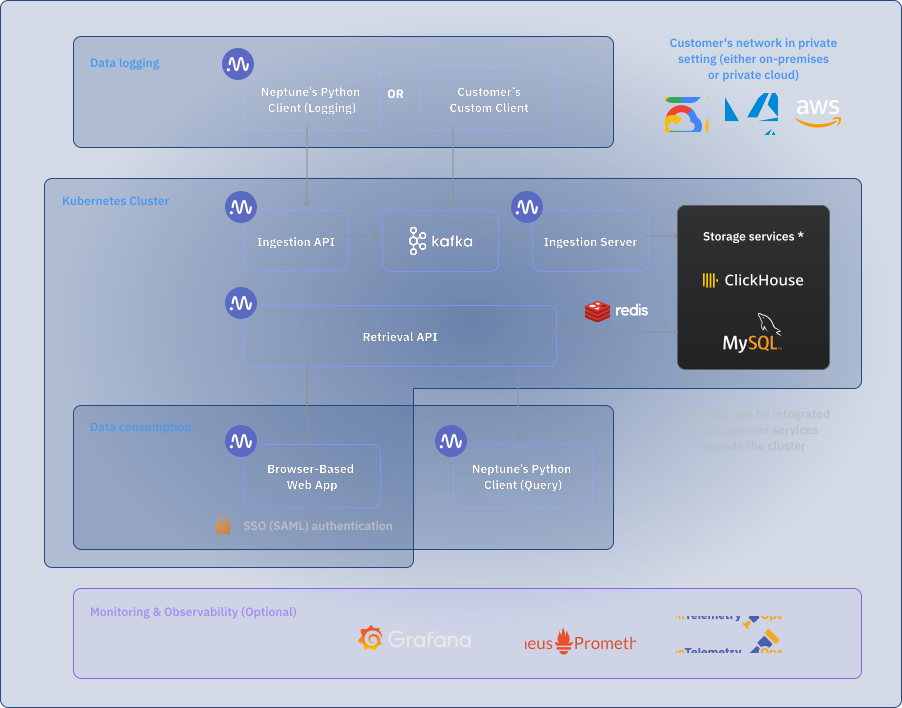
Neptune’s core architecture was built to handle the demands of monitoring the largest training workflows. From strict security requirements to scaling ingestion, every aspect is engineered to support your specific needs and run seamlessly in your environment.

+1M datapoints/second
+1M datapoints in <1s
logged metadata
 Deployment options
Flexible deployment to match your infra and compliance needs
Deploy Neptune on your own hardware, behind your firewall, with fully air-gapped deployment supported.
Install Neptune within your virtual private cloud. Supported Clouds include AWS, GCP, and Azure.
Fully managed by Neptune, single-tenant deployment on a dedicated cloud instance provisioned just for you.
 Checklist
Everything you’d expect from a self-hosted solution
-

Kubernetes-only deployment: Helm Charts provided. Runs as non-root containers. No special K8s privileges required.
-
Bring your own services: Decomposable deployment architecture that allows for integrating with your Kafka, MySQL, ClickHouse, or Redis. Optional use of managed services.
-
Fully managed option available: We can operate Neptune on your infrastructure with proactive monitoring and alerting, backups, and 24/7 support.

-
Multi-zone deployments: Single-region HA with workloads distributed across availability zones.
-
Backup & DR: Daily consistent backups with minimal ingestion freeze (below 1 min); offsite backup within the same cloud provider supported.
-
Horizontal & vertical scaling: Available on demand; Neptune components can be scaled independently.
-
Tiered storage support: SSDs used for recent data to ensure fast access, and HDDs for storing historical data efficiently.
-
Storage scalability: Ability to scale storage (ClickHouse) independently.
-
SSO/LDAP integration (SAML 2.0): Supports Okta, OneLogin, and custom identity providers.
-
Designed around SOC 2 principles: The architecture and processes follow security best practices for handling sensitive data.
-
Private deployments with full network isolation: Support for air-gapped deployment.
-
Built-in Prometheus, Grafana, OpenTelemetry or forward logs and metrics to your existing tools.
-
Dashboards and alerts: A configured set of Grafana dashboards and alerts provided (e.g., for ingestion and retrieval disruptions).
-
Dedicated test environments: Separate license for staging environments and upgrade validation.
-
Seamless upgrades with minor ingestion pause: Retrievals stay online during upgrades; ingestion may pause briefly (up to 5 mins) with no impact on training jobs (data is queued).
 Next steps
How to get started with self-hosted Neptune
Review prerequisites & docs
Ensure a smooth start by understanding what’s needed.
- Check system prerequisites
- Review architecture and installation documentation
- Evaluate environment compatibility
Talk to us
Let’s align on your needs, ideal setup, and expectations.
- Discuss your team’s specific requirements
- Explore deployment options
- Get tailored recommendations about instance size and configuration
Deploy a proof of concept
Test Neptune in your environment before full commitment.
- Guided POC setup — with the right prerequisites, it’s typically done in 1 day
- Live demos, Q&A sessions, and technical support
- Validate performance and integration
Move from POC to full-scale use with confidence.

Yes, you can bring your own services and other answers
-
Depending on your setup, it may be possible to deploy and use Neptune without Kubernetes.
We’ve seen a wide range of production environments. If you’re unsure whether Neptune fits your infra, reach out, we’re happy to talk through it.
-
Yes. You can bring your own Kafka, MySQL, ClickHouse, Redis, and storage layers. If not available, all of these can be part of the Neptune deployment.
-
Yes. Neptune supports tiered storage in ClickHouse. Frequently accessed data goes on SSD, and older data can move to cheaper/higher‐latency storage.
-
No. All services can be deployed in an air-gapped environment. No forced external connectivity is required.